

Can the sun replace your campsite outlet? (Spoiler: some of these actually will.)
I never head into the backcountry without a solar charger. Phones die, maps go dark, and I like my playlists alive. I’ve forgotten socks more times than chargers — trust me, you want this covered.
I tested five reliable options so you don’t have to. Short hikes, multi-day trips, or group camping — each pick balances power, portability, and real-world performance. No fluff. Just what works when the grid is gone.
Top Picks


40W Foldable USB-C USB-A Solar Panel
I trust this 40W panel when I need reliable daytime throughput for multiple devices or to recharge larger power banks. It consistently outperforms smaller panels in real-world conditions, but you still need a compatible battery if you want stored energy after sundown.
Why I pick this panel for longer outings
When I'm planning a multi-day trip or need to recharge a sizable power bank at camp, this 40W foldable panel is my go-to. It provides the kind of sustained current that smaller panels can't match, and the inclusion of both QC and PD fast-charge ports means I can charge phones and input into compatible batteries at higher rates.
Standout features and field performance
In real sun I can recharge a large power bank in a day and keep multiple devices topped up through peak sun hours. I also find the smart IC chip helps stabilize charging through minor shading or angle shifts — though full sun is still best.
Practical considerations and tips from my use
Conclusion
This is the panel I reach for when I want reliable, fast solar input without hauling rigid gear. It's an investment in charging performance and real-world usefulness on multi-day trips.
49,800mAh Solar Power Bank with Cables
I consider this an excellent power hub for long outings, group camping, or emergency kits because of its massive capacity and versatile outputs. The solar input is a helpful backup but slow — the core value is the huge battery and built-in cables.
Who this is for
I pack this ERRBBIC power bank when I'm heading on long car-camping trips, group outings, or when building a home emergency kit. With nearly 50,000mAh, it behaves like a portable battery station — I can run multiple phones, a tablet, speakers, and lights for days. The built-in cables remove the need to juggle cords, which is a practical convenience in a campsite.
Features I use and appreciate
Because the internal battery is so large, I rely on wall charging before trips; the solar panel is a backup top-up method while out in the field. The flashlight and SOS mode are real practical additions when hiking at dusk or finding gear in camp.
Limitations and how I work around them
Verdict from the field
If you want a single device that can keep multiple people powered for several days and doubles as a lamp and emergency tool, this is a great choice. Just be realistic about solar recharge speed and carry the unit in situations where weight isn't the first constraint.
28W BigBlue Solar Charger with Ammeter
I appreciate the BigBlue for its high cell efficiency and the integrated ammeter that shows real-time output — that makes optimizing placement easy. It's a premium 5V solution for campers who want measurable performance, though you must manage device heating and shading carefully.
Performance and unique monitoring feature
I use this BigBlue panel when I want to know exactly how much current I'm harvesting — the digital ammeter is the feature that sold me. With up to 28W output and very efficient cells (25.4% claimed), it reliably charges phones and power banks faster than many similar-sized panels. The ammeter helps me position the panel for best angle and judge whether a cloud bank is killing output.
Design and field behavior
In camp I often leave the panel propped toward the sun and check the ammeter periodically; that simple feedback has improved my midday harvest substantially. For charging multiple power banks, it performs admirably in good sun.
Practical cautions and tips
Final thought
I recommend this panel to campers who want a high-efficiency charger and like monitoring their harvest. It's a step up from basic foldables thanks to the readout and cell quality, but it still requires sensible placement and device management to get the best results.
20W Foldable USB-A USB-C Charger
I rely on this panel when I need an ultra-light way to top up devices during day hikes or short camps. It delivers surprisingly strong output for its size, but remember it doesn't store energy — pair it with a battery pack for night use.
What it is and who it suits
I keep this 20W foldable panel in my daypack for short trips and emergency kits. Its core purpose is to provide direct solar charging to phones, small tablets, and power banks while you're in sunlight. Because it doesn't store energy, I use it alongside a separate power bank so I can collect energy during the day and use it at night.
Key features and real-world benefits
These features mean I can hang the panel from my pack or set it in camp and get steady charging for phones and USB devices. In full sun it charges noticeably faster than cheaper PET panels, and the ETFE surface is easier to clean after a dusty hike.
Limitations and practical tips
When I pick this panel
I reach for this unit when weight and packability matter but I still want a usable throughput. For single-day hikes and as a backup emergency charger it's excellent; for multi-day basecamp use I'd pair it with a larger bank or a higher-watt panel.
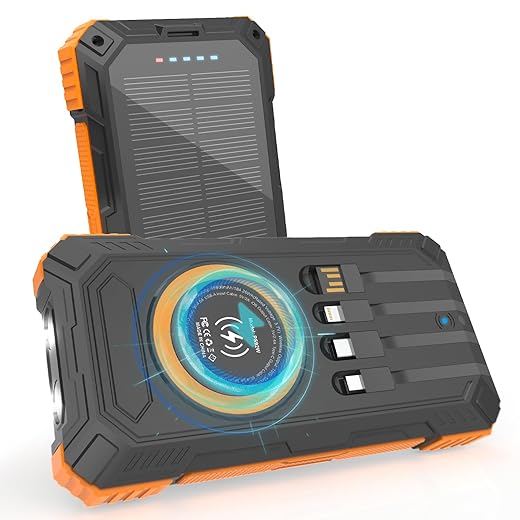
10,000mAh Solar Wireless Power Bank
I like this as a grab-and-go backup for short trips where you want some solar topping but don't want bulk. It has solid day-to-day usability and wireless charging, but the solar recharge is slow and inconsistent — treat the panel as an emergency top-up rather than a primary charge source.
Overview and intended use
I view this BLAVOR unit as a compact power bank that adds solar convenience rather than a full off-grid solution. With 10,000mAh and 20W USB-C output, it covers a couple of phone charges and provides a wireless pad for phones that support Qi. The built-in flashlight and modest ruggedization make it a sensible choice for day hikes, quick camps, or as an in-car emergency backup.
Notable features I use often
In practice I charge phones wired when I need speed and use the wireless pad when I want convenience at camp. The flashlight has saved me from fumbling in the tent more than once.
Limitations and practical advice
Bottom line
I keep one of these in a glove box and another in my daypack. For the size and price it's a convenient, capable backup — just don't expect it to replace wall charging for long trips.
Final Thoughts
I recommend two clear winners depending on how you camp.
40W Foldable USB-C USB-A Solar Panel — Best for basecamp and multi-device charging. I trust this panel when I need solid daytime throughput to power phones, tablets, or to top off a larger power bank. It delivers the highest real-world output of the group and holds up well in variable light. Actionable tip: use it to recharge a high-capacity battery during the day (angle toward the sun, avoid shading), then draw from the battery after sundown.
49,800mAh Solar Power Bank with Cables — Best for long trips and emergencies. I bring this when I need raw capacity for multi-day trips or for group use. The built-in cables and huge battery mean I can jump from device to device for days. Expect slow solar recharge — so charge it from AC before the trip and treat the panel input as an emergency top-up.
If you want an ultralight daytime top-up for hikes, the 20W Foldable USB-A USB-C Charger is my go-to backup, but for dependable campsite power combine the 40W panel with the 49,800mAh power bank and you’ll cover almost every scenario.
Funny thing: I grabbed the tiny 20W foldable for a ultralight hike and it actually surprised me. Lightweight + waterproof = win.
Not going to replace a wall charger, obviously, but for topping up a GPS and phone mid-day it was perfect. If you’re counting every ounce, this is a solid pick.
One gripe — the fold latch on mine got bent after a rough pack toss. Anyone else have build quality issues?
No latch problems here but I always pack it between soft layers. Guaranteeing it won’t get bashed helps a lot. Maybe a small sleeve would prevent that.
Thanks for sharing — the 20W panel is indeed aimed at ultra-portability. Small mechanical parts can be vulnerable to rough handling; a padded sleeve is a good preventive measure.
BigBlue 28W owner here — short review and a question:
I love the digital ammeter. It actually made finding the best orientation fun (nerd alert ?).
On hot days my phone got warm while charging from the panel — anyone else notice heat issues? Is that just how it is when it pushes higher amps?
Also, would you all recommend unplugging when the phone reaches 80% to avoid heating? Trying to be battery-smart.
I solved it by charging into a power bank instead of directly to the phone. The bank takes the solar input better and then I trickle the phone from the bank in shade.
Interesting tip — I never thought of shading the phone separately. Will try that next weekend.
Great question — heat can be from both charging electronics and ambient sun. Shading the device while keeping the panel exposed is a good strategy. Also avoid blocking airflow around the phone.
Phones can heat up when fast-charging + sun. I try to keep the phone shaded while the panel faces sun, and use the ammeter to dial back by partially shading the panel. Unplugging at 80% is reasonable if you’re worried about temps.
Has anyone tried the BLAVOR 10,000mAh for wireless charging on trail runs? I’m intrigued by the wireless, but worried about slow solar recharge when I’m away for a few days.
I like the idea of something compact I can toss in a daypack. Any tips if I bring this on a weekend camp?
The BLAVOR is great for short outings. Wireless is convenient but slower and less efficient — I keep it as a convenience feature. Bring it fully charged; expect only trickle from the solar panel.
Short answer: it’s perfect as a compact backup. Charge fully before you leave and treat the solar as an occasional top-up rather than the primary recharge method.
If you want wireless, it’s nice — but wireless + direct sun = more heat, so monitor temps. Otherwise wired charging to the BLAVOR is faster and more reliable.
Long-ish note because I had a weird combo setup that worked well:
I used a FlexSolar 40W to recharge a big battery (ERRBBIC 49800mAh) over a couple of sunny days while car-camping. The panel fed the power bank during daylight and we ran phones/LEDs off the bank at night.
Pro tip: disconnect the battery when you’re done charging for the day — the bank’s own thermal management seems happier that way and charging efficiency was better the next morning.
Just want to say: pairing a big panel with a big bank felt like the ‘camping power station’ we always wanted. Worth the extra kg if you’re car camping.
Excellent field report — pairing high-output panels with high-capacity banks is exactly the scenario where you see the best real-world results. Thanks for the tip about disconnecting; thermal management can indeed affect charge cycles.
This is the kind of real-world setup I was hoping to hear about. Car-camping this fall so might try the same combo. Any brand preference for cabling/adapters?
Bring thick short cables for better efficiency — cheap long thin cables lose volts and make charging slower. I got stranded with a lanky USB-A extension once, lesson learned.
Great roundup — thanks! I’ve been eyeing the FlexSolar 40W for a group trip next month.
It sounds perfect for charging multiple phones and topping up a power bank during the day.
Quick question: does anyone have experience mounting it on a tarp vs laying it flat? I’m worried about shading from tree branches.
Also curious if the USB-C output is strong enough to feed a big 20,000mAh power bank quickly or if I should prioritize direct sun placement.
Sorry for the essay, I’m just trying to avoid a dead phone situation on my family trip!
If you plan multi-device use, consider pairing the FlexSolar with a quality battery pack. Use the panel to refill the bank during the day, then recharge devices overnight from the bank — much less stressful.
I mounted mine on my tent pole with a bungee and it was OK. If you can, prop it up on a stiff stick and keep it clear of branches. Shading kills performance faster than I expected ?
Thanks Sarah — glad it helps! The FlexSolar performs best when fully exposed to sun with the panel angled perpendicular to the sun. Tarp mounting can work if the panel gets direct sunlight; even small shadows on part of the array can reduce output a lot. For a 20,000mAh bank, the USB-C will charge it decently during peak sun, but you’ll still want to leave it for several hours — it’s not instantaneous.
Minor nitpick — the roundup mentions waterproofing for several panels, which is great, but can we get a comment on dust/sand resistance too? I camp on beaches and tiny grit gets everywhere and I worry about micro-scratches reducing efficiency.
Also, haha, who else has an extra tangled mess of built-in cables after every trip? ????
Good point. ETFE and IP67 ratings help with moisture, but sand and grit are more of a mechanical wear issue. Wiping panels with a soft cloth after a beach day helps; avoid abrasive scrubbing. For beach trips, a panel with a protective coating like ETFE will resist micro-scratches better than plain PET cells.
Totally — I keep a small microfiber and a zip-top bag for panels on beach trips. Keeps sand off and makes cleanup easy.
I bought the ERRBBIC 49800mAh after reading this article and took it on a 5-day canoe trip.
Pros: the capacity is insane and the built-in cables were a lifesaver (no extra cords). Dual flashlight is actually handy at night.
Cons: the solar input is sloooow — it charged maybe 5-10% after a bright day strapped to the kayak. So treat solar as backup not main charging method.
Would still recommend for groups though.
Yup, same here. The capacity is the main draw. I leave it on my gear shelf to charge on AC before trips and use the solar only for emergencies.
Did you find the unit heavy? I’m torn between bringing it or a lighter 20k pack. For canoeing weight matters a lot.
Good practical takeaway — thanks for sharing your trip notes. The article highlights the ERRBBIC as best for long trips and emergencies for exactly those reasons.
Thumbs up for the helpful buying guide. Quick comparison note from me: if you’re backpacking solo and weight is #1, go 20W. If you’re with a crew or want peace of mind during longer trips, the ERRBBIC or pairing FlexSolar + large bank is the way.
Also love the humor in the article (made me actually read the specs instead of skimming).
Thanks Robert — that weight vs capacity tradeoff is the key decision for many people. Appreciate you highlighting it succinctly.
Agreed, the article helped me decide between lugging the big ERRBBIC or being minimalist. Went middle-ground and glad I did.