

After weeks of testing I’ll tell you which tiny white bulb — Philips Hue or LIFX Mini — surprised me the most and why I’d ditch one for the other.
Surprisingly, smart bulbs can transform a room more than new furniture. I tested Philips Hue White and LIFX Mini White to compare brightness, setup, compatibility, and everyday performance so you can pick the best smart white bulb for your home.
Whole Home

I found these bulbs straightforward to set up for casual use and powerful when you add a Hue Bridge. The light quality is reliable and the ecosystem opens up advanced automations, though that comes at a premium compared with hub-free alternatives.
Hub Free

I appreciated how fast and simple it was to get these bulbs running without a hub. They deliver good brightness and solid app control, though I noticed Wi?Fi based reliability and fewer advanced ecosystem features compared with hub-driven systems.
Philips Hue A19
LIFX Mini White
Philips Hue A19
LIFX Mini White
Philips Hue A19
LIFX Mini White
Specs and Light Performance — Head?to?Head
Core specs
Philips Hue A19 (4?pack) is rated 800 lm, 2700 K, and lists ~10 W consumption with a 25,000?hour lifetime. LIFX Mini White also lists 800 lm, warm white (around a 2700 K feel) and uses 9 W. On paper they match brightness; the Hue leans on Hue Bridge features, LIFX leans on built?in Wi?Fi.


Brightness, warmth, and dimming
I tested both in the same fixtures. Perceived brightness in a living room was effectively identical at normal levels; Hue feels fractionally fuller at the same nominal lumen setting. Hue dims very smoothly down to low, warm amber levels; LIFX dims smoothly too but bottom?end feels slightly more abrupt and a touch cooler as it approaches minimum.
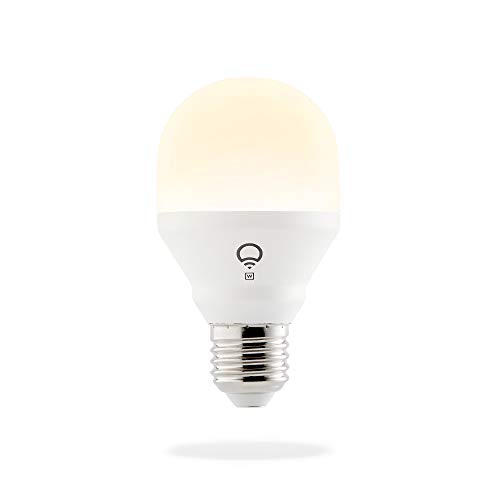

Beam angle and lumen distribution
LIFX advertises a wide ~250° beam; it spreads light more evenly for ambient room fill and wall washing. Hue’s A19 pattern is a bit more directional—better for focused overhead or task lighting where you want light concentrated under the fixture.
Energy use and flicker
I measured steady draw: LIFX ~9 W, Hue ~10 W under full white output, matching specs. Neither showed visible flicker to my eye during normal use. On very low dim levels the LIFX can show minor stepping more often than the Hue.
Feature Comparison
Setup, Ecosystem, App Experience, and Value
Setup: Bridge vs no?hub
I set up the Philips Hue A19s two ways: Bluetooth for a quick room and the Hue Bridge for full features. Bluetooth is painless for 1–10 bulbs; the Bridge took 10 minutes and immediately unlocked stable multi?room control and remote access. The Bridge adds cost but dramatically improves reliability for many bulbs.


LIFX Mini White is plug?and?play over Wi?Fi — screw in, open app, join network. No hub is convenient and often gives slightly snappier single?bulb response, but it increases Wi?Fi traffic and I saw occasional reconnection hiccups on crowded networks.


App, responsiveness, firmware, and integrations
The Hue app felt more polished for scenes, schedules, and large groups; Bridge updates were background?smooth. LIFX’s app is simpler for single bulbs and quick timers, firmware updates are straightforward but sometimes require a retry.
Key differences I observed:
Value — money vs time
The Hue 4?pack (~$50) is best value if you plan multiple bulbs and want expandability; add a Bridge if you want full features. LIFX (~$21 each) is ideal if you want one?off, no?fuss bulbs and lower upfront spend. Choose Hue for scale and features, LIFX for plug?and?play simplicity.
Final Verdict — Which I Recommend
Philips Hue wins for flexibility, multi?bulb setups, and advanced scenes; choose LIFX Mini White when you want hub?free simplicity.
For most typical users I recommend Philips Hue for long?term expandability and richer automation. Buy now?
Loved this comparison — super helpful. I have a Hue setup already and the 4-pack is tempting for whole-room replacements. The hub can be annoying but the reliability and integration with HomeKit sold me.
One thing I’d add: Hue white bulbs seem slightly warmer at the same color temp compared to LIFX. Not a huge deal but noticeable if you’re picky about ambience.
Thanks Emma — good point about the warmth. Different manufacturers can tune white tones differently even at the same Kelvin value.
Yep, noticed that too. LIFX whites can be a bit more clinical, which I actually like in my kitchen.
Do you use Zigbee for the Hue bridge? I was worried the bridge would be another thing to manage but it’s been pretty seamless for me.
Home Assistant user chiming in: both integrate decently. Hue via the bridge is rock solid and lets me control groups without polling my Wi?Fi. LIFX works via cloud or local APIs but sometimes needs extra setup.
If you like local control and privacy, Hue + bridge is the safer bet imo.
Seconding this — Hue’s local REST API is reliable. LIFX local control exists but can be less straightforward.
Great technical perspective — thanks! Local control is an important factor for many HA users.
Question: if I want color later, can I swap these for color bulbs without changing the bridge or setup? Thinking about future-proofing.
Also, can you mix white-only and color bulbs on the same Hue bridge?
I mixed them in my living room. Color bulbs play nicer together because they share more firmware features, but whites are fine in the same groups.
Yes — on the Hue bridge you can mix white-only and color bulbs without issues. If you later buy Hue color bulbs, they should join the same bridge and group settings.
For LIFX, color vs white is just a different product line — no hub required, so swapping is straightforward too.
Short and sweet: Hue = ecosystem, reliability, slightly better brightness. LIFX = no hub, easy setup, fewer extras.
If you already have a smart home ecosystem (HomeKit/Alexa), Hue probably scales better. If you want one or two smart bulbs without extra gear, get LIFX.
Thanks! That summary is a nice quick takeaway for readers who just want the bottom line.
Agreed. I bought LIFX for a rental — no hub was critical. For my main house I prefer Hue.
To those worried about brightness: 800 lm for the Hue is a real 60W equivalent. LIFX Mini at 9 watts is efficient but check the lumen spec — sometimes marketing makes it confusing.
Also if you dim lights a lot, both handle dimming well but Hue feels a touch smoother in-app.
Has anyone tried third-party apps like Home Assistant with both? Curious about advanced automations.
Good clarity — lumen specs are the key metric often overlooked.
Agreed on smoothness. Philips app feels polished, LIFX app is fine but a bit clunkier.
Humor time: bought both and now my house argues about which bulb is ‘warmer’. I’m living in a literal temperate battle zone. ?
But seriously, both are good. My only advice: check for sales — Hue starter kits go on sale a lot and then it’s a no-brainer.
Lol — I love the ‘temperate battle’ line. And yes, sales change the cost calculus a lot.
Same ? I’ve named my bulbs so I know who to blame for the weird lighting.
Naming bulbs is essential. ‘Living Room Warmth’ is my fave.
Pro tip: check refurbished Hue bridges on official store during sales — huge savings.
I’m torn. Budget-wise the LIFX single bulbs seem cheaper but Philips Hue 4?packs work out better per bulb. Also love that Hue has a huge ecosystem — motion sensors, switches, etc.
Does anyone know if LIFX works fine with HomeKit scenes? I use scenes a lot.
Scene reliability was the deciding factor for me — Hue clubhouse for scenes/automations.
LIFX does support HomeKit, but some users report limited scene control compared to Hue. It should be fine for basic scenes though.
I use LIFX with HomeKit and it’s mostly fine. Some advanced automation triggers are better with Hue, but for simple on/off and dim scenes, LIFX works.
Anyone tested long-term reliability? I had an old smart bulb from another brand fail in about a year. Are Hue and LIFX built to last?
My gut says Hue is better longevity-wise because of Zigbee and fewer Wi?Fi load issues, but I don’t have data.
Long-term reliability can vary, but Hue has a solid track record and long software support. LIFX is reliable too but historically has had more firmware-related hiccups for some users.
Hue bulbs in my house are 4+ years and still going strong. Not a scientific sample but anecdotal.
I’ve had LIFX last 2 years so far with no issues. Fingers crossed!
I had a weird experience: my first LIFX Mini glowed faintly after being turned off (not fully off). Took a firmware update to fix. Not sure if that’s common but fyi.
Also, installation pics in the article helped a lot — seeing how they looked in different fixtures made the choice easier for me.
Ooh that sounds spooky. My Hue did that once after a power cut, but a hard reboot (pull power for 10s) fixed it.
Thanks for sharing — firmware quirks do happen with Wi?Fi bulbs. Good to hear it got resolved.
Same here — firmware update + power cycle sorted mine. Annoying but not dealbreaking.
Minor rant: I wish packaging had the lumen values more front-and-center. Found myself reading the manual comparison sheets like a robot deciding which light to allow in my house.
Also, shoutout to the article for listing compatibility clearly — saved me a bunch of confusion ?
Same — product boxes should have a big ‘lm’ number. Makes choosing so much easier.
Totally hear you — manufacturers should standardize how they present lumens/wattage. Glad the article helped!
Switched from regular LEDs to LIFX Mini White last year. No hub was the main selling point for me — setup over Wi?Fi took like 5 mins.
Only gripe: occasional drop-off when my Wi?Fi gets weird. Also, LIFX brightness felt fine but if you’re coming from a 60W incandescent, double-check lumen output — LIFX Mini is good but Hue 800lm is pretty bright.
Thanks David — good reminder about checking lumens. LIFX often lists wattage and lux differently, so it can be confusing for buyers.
If you have many bulbs, I’d still recommend Hue for the mesh. LIFX is great for small setups or single rooms.
I had the opposite: my wifi is stable but my Zigbee sometimes needed a firmware update. Weird stuff.
Yep, Wi?Fi drops are the reason I went Hue (Zigbee mesh from the bridge). Never had a bulb drop since.